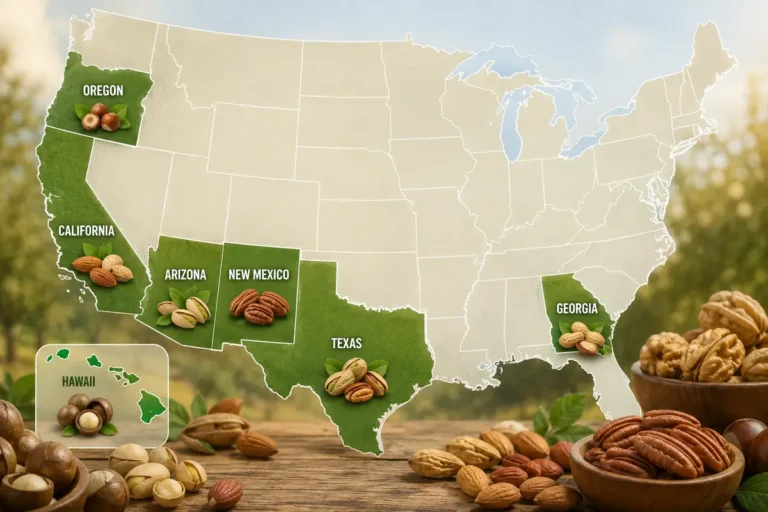
U.S. Tree Nut Exports: Products, Markets and Trends
Where do U.S. tree nuts go after harvest? From California almonds and pistachios to walnuts and American pecans, export markets and processing formats are shaping the next phase of U.S. nut trade.
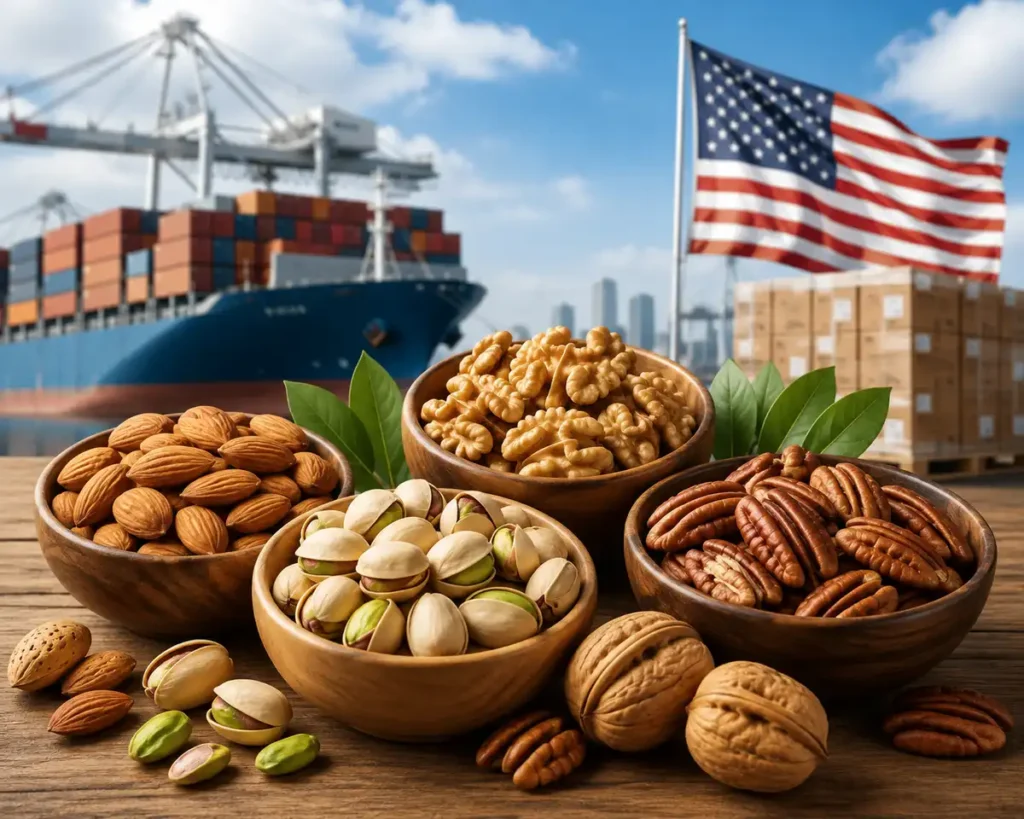
The United States is a major global supplier of tree nuts, with almonds, pistachios, walnuts and pecans forming a large part of its export trade. California is especially important, producing most U.S. almonds, pistachios and walnuts, while pecans are grown across several Southern and Western states.
For U.S. growers, processors, exporters, food manufacturers and buyers, exports are closely linked to crop size, product form, overseas demand, tariffs, freight and food regulations.
Recent USDA data also show how strongly international trade affects U.S. tree nut supply and pricing. See the key products, processing forms, markets and trade trends shaping the industry.
Which tree nuts does the U.S. export?
The main U.S. tree nut export products include:
- Almonds
- Pistachios
- Walnuts
- Pecans
- Smaller export categories such as macadamia nuts and other specialty tree nuts
Almonds are the largest export category by volume. In the 2024/25 marketing year, the U.S. exported 2.01 billion pounds of almonds on a shelled basis, the second-highest export volume on record.
Pistachios are also heavily export-oriented. USDA reported U.S. pistachio exports of 487 million pounds on a shelled basis in 2023/24, up 49% from the previous year. Exports represented 57% of total U.S. pistachio supply that season.
Also read: Top Tree Nut Producing States in the USA
Main U.S. tree nut products
U.S. exports are not limited to raw nuts. Buyers can source products in several forms depending on their food application.
| Tree nut | Common commercial forms | Typical applications |
|---|---|---|
| Almonds | In-shell, whole kernels, sliced, slivered, diced, flour, butter | Snacks, bakery, confectionery, dairy and plant-based foods |
| Pistachios | In-shell, whole kernels, halves, pieces, meal, paste, butter | Snacks, bakery, ice cream, confectionery |
| Walnuts | In-shell, halves, pieces, processed kernels | Bakery, snacks, cereals, confectionery |
| Pecans | In-shell, halves, pieces, meal/flour, oil | Bakery, snacks, confectionery, food ingredients |
Almonds have a particularly broad processing range. Processing can include blanching, slicing, slivering, dicing, grinding, roasting, sorting and screening.
Pistachio kernels are also sold as halves, pieces, meal, flour, paste, butter and oil. These forms allow processors to use the same crop across products ranging from bakery items to frozen desserts and confectionery.
How are U.S. tree nuts processed for export?
Processing usually starts after harvest with cleaning, sorting, sizing and removal of foreign material or defective nuts. The exact process depends on the crop and the final product.
For almonds, processors may shell the nuts and then produce whole kernels, sliced or slivered almonds, diced products, roasted almonds, meal, flour, butter and other forms.
Pistachios can be marketed in-shell or processed into kernels. Kernel sizes and forms are selected according to the buyer’s application. Smaller pieces can be used in doughs, ice cream, frozen desserts and confectionery, while pistachio meal can be used in bakery products or as a base for paste and fillings.
For commercial buyers, processing level matters because it affects handling, storage, specifications, pricing and the type of manufacturing equipment required at the destination.
Where do U.S. tree nuts go?
U.S. tree nuts are sold across Asia, Europe, the Middle East, North America and other regions.
India is an important market for U.S. almonds. USDA’s Foreign Agricultural Service reported that the United States supplied about 140,171 metric tons of India’s almond imports in MY 2024/25, accounting for 86% of total imports.
Pistachio trade is spread across several major markets. USDA identified China, the European Union, Turkey and India among the leading destinations for U.S. in-shell pistachios during the first five months of MY 2024/25. China accounted for 35% of export volume during that period.
California walnuts also depend heavily on international demand. The California Walnut Commission says over two-thirds of California walnuts are exported, making overseas sales an important part of the industry.
American pecans have established markets in Europe and North America, while industry export programs are also focusing on opportunities in Asia, including India and China.
Also read: Latest Tree Nuts Industry Markets News, Insights, and Updates
What is changing in U.S. tree nut exports?
Several trends are shaping the U.S. tree nut export business.
1. Export demand remains central to the industry
Tree nuts have become an important part of U.S. high-value agricultural exports. USDA ERS notes that the share of U.S. agricultural exports represented by high-value raw products has expanded since 1990, largely due to tree nuts, especially almonds and pistachios.
2. Crop cycles can change export availability
Tree nut production does not move in a straight line every year. Pistachios, for example, follow an alternate-bearing cycle. USDA reported that the 2024 California pistachio crop was expected to be 26% below the 2023 record, but still the third-largest crop on record at that time.
Walnuts faced a different supply situation. USDA reported that U.S. walnut production fell to 603,000 tons in 2024/25, down 27% from the previous year’s record. U.S. walnut export unit values subsequently increased by more than 50% from September 2024 through July 2025.
3. Processed formats create additional demand
Exporters are increasingly dealing with buyers that need specific forms rather than basic in-shell products. Sliced almonds, diced nuts, pistachio pieces, flour, meal, paste and butter can serve food manufacturers with different formulation needs.
4. Trade policy can affect market access
Tariffs remain an issue for some U.S. tree nut exporters. USDA ERS reported that Turkey increased its most-favored-nation duty on almonds and walnuts in 2023, adding to the tariff burden on U.S. exports.
China is another important example. USDA’s 2025 China report noted that tariffs had reduced the U.S. share of China’s pecan imports, while South Africa and Mexico gained ground.
5. Market diversification remains important
Recent industry programs show continued investment in export development. In 2026, the American Pecan Council received $1.2 million through the USDA America First Trade Promotion Program to support international market development. California Walnuts also received $3.66 million through the 2026 Market Access Program, alongside existing Regional Agriculture Promotion Program funding.
U.S. tree nut export data at a glance
| Indicator | Latest reported figure |
| U.S. almond exports, MY 2024/25 | 2.01 billion lb, shelled basis |
| U.S. pistachio exports, MY 2023/24 | 487 million lb, shelled basis |
| California almond bearing acreage, 2024 | 1.38 million acres |
| California pistachio bearing acreage, 2024 | About 488,000 acres |
| U.S. walnut production, MY 2024/25 | 603,000 tons |
Sources: USDA ERS and USDA FAS.
What should U.S. tree nut buyers and exporters watch?
The main factors are crop forecasts, export volumes, inventory levels, overseas demand, tariffs, freight costs, food regulations and the shift toward processed nut ingredients.
For buyers, product specifications and processing form should be defined before sourcing. For exporters, relying on a single overseas market can increase exposure to tariff or demand changes.
The U.S. tree nut export business is therefore shaped by both the size of the crop and what happens after harvest. Processing capacity, product formats, international market access and changing buyer requirements will continue to influence where U.S. tree nuts are sold and how they are valued.
Frequently Asked Questions (FAQs)
What are the main U.S. tree nut exports?
Almonds, pistachios, walnuts and pecans are the main U.S. tree nut export categories.
Which U.S. tree nut has the largest export volume?
Almonds lead by export volume. The U.S. exported 2.01 billion pounds in MY 2024/25 on a shelled basis.
Which countries buy U.S. tree nuts?
Major markets include India, China, the European Union, Turkey, Japan, Canada, Mexico and countries in the Middle East.
What forms of tree nuts can U.S. exporters supply?
Depending on the nut, exporters can supply in-shell nuts, kernels, halves, pieces, sliced or diced products, roasted nuts, flour, meal, paste, butter and other processed forms.
Why do crop conditions matter to exporters?
Changes in production affect available supply, inventories, export volumes and prices. Walnut and pistachio data from recent marketing years show how crop cycles can affect trade.
Image credit: Nut Insights
Sources:
- Fruit and Tree Nuts Data – Trade and Prices by Category and Commodity / USDA Economic Research Service USDA ERS trade and prices data
- Fruit and Tree Nuts Outlook: September 2025 / USDA Economic Research Service USDA ERS September 2025 Outlook
- Fruit and Tree Nuts Outlook: March 2025 / USDA Economic Research Service USDA ERS March 2025 Outlook
- Pistachios crack walnuts’ long-standing spot in California’s tree nut acreage ranking / USDA Economic Research Service USDA ERS California tree nut acreage report
- Tree Nuts Annual / USDA Foreign Agricultural Service USDA FAS Tree Nuts Annual
- Tree Nuts Annual, India / USDA Foreign Agricultural Service USDA FAS India Tree Nuts Annual
- Tree Nuts Annual, China / USDA Foreign Agricultural Service USDA FAS China Tree Nuts Annual
- Almond Forms / Almond Board of California Almond Board of California almond forms
- Forms of Pistachios / American Pistachio Growers American Pistachio Growers product forms
- Targeting Export Markets to Drive Success / California Walnuts California Walnuts export markets
- Exports and international markets / American Pecan Council American Pecan export markets
Recent Articles
Follow us to receive updates🔔