
California Almond Production 2026: Acreage, Yield & Outlook
California almond production in 2026 is forecast at 2.7 billion pounds. See acreage, yield, crop estimates, harvest progress and industry outlook.
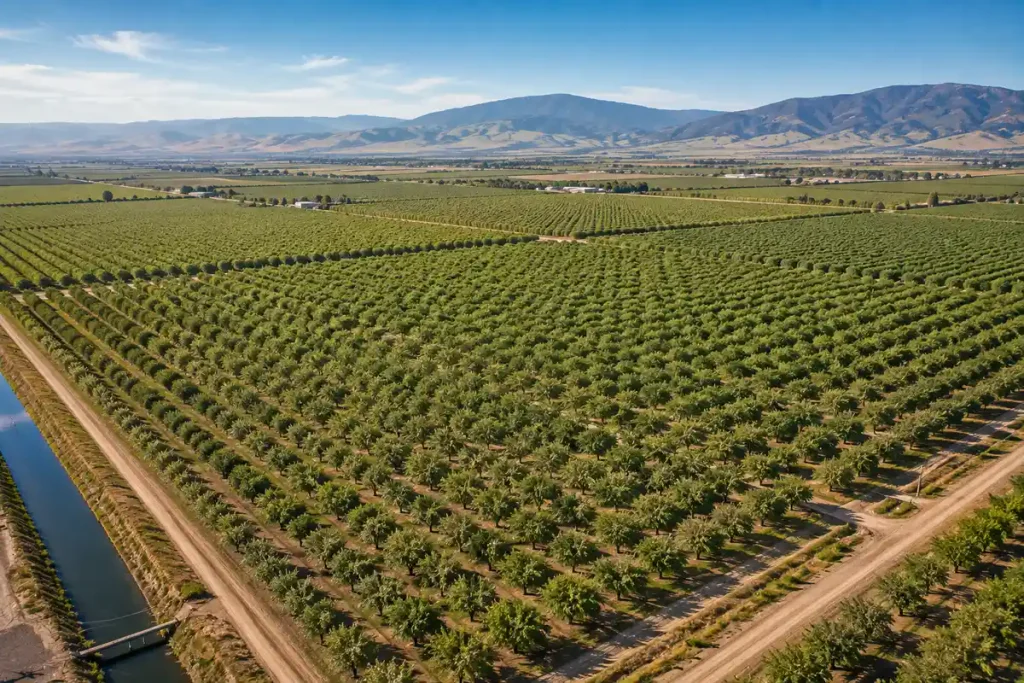
California remains the center of U.S. almond production, but the 2026 crop is expected to be slightly smaller than the previous season. USDA’s May 2026 forecast puts California almond production at 2.70 billion pounds on a shelled basis, down 1% from the 2.715 billion pounds estimated for 2025.
Forecast bearing acreage is 1.39 million acres, while yield is expected to remain at 1,940 pounds per acre.
The outlook has become more cautious as the crop moves into harvest. Land IQ reported a decline in bearing acreage, while field observations from Blue Diamond Growers pointed to variable orchard conditions, advanced crop maturity and some downward pressure on crop potential.
California almond production forecast for 2026
The USDA forecast is the main official benchmark for the 2026 California almond crop. It is based on a survey of about 500 almond growers conducted in April and May.
| Indicator | 2025 | 2026 forecast | Change |
|---|---|---|---|
| Bearing acreage | 1.40 million acres | 1.39 million acres | -0.7% |
| Yield | 1,940 lb/acre | 1,940 lb/acre | No change |
| Production | 2.715 billion lb | 2.70 billion lb | -0.6% |
Source: USDA NASS May 2026 Crop Production report.
The small production decline is mainly linked to lower bearing acreage rather than a lower forecast yield. USDA expects yield to remain unchanged at 1,940 pounds per acre.
For almond processors, exporters and buyers, that distinction matters. A stable yield means orchard productivity is not expected to fall at the USDA forecast level, but fewer productive acres can still limit total crop volume.
Also read: U.S. Tree Nut Exports: Products, Markets and Trends
Almond acreage is falling for the first time in decades
California’s almond acreage story is changing. Land IQ’s initial 2026 estimate put bearing acreage at 1,385,870 acres, down 15,227 acres from its 2025 final estimate of 1,401,097 acres.
According to the Almond Board of California, this was the first year-over-year decline in bearing almond acreage since 1995. Land IQ also estimated 47,588 acres of orchard removals during the period covered by its 2026 initial estimate.
The decline does not mean California is losing its position as a major almond-producing region. It does show that the industry is moving through a period of orchard removals and slower new planting.
Land IQ’s initial acreage figure is also different from USDA’s 1.39 million-acre forecast because the two figures come from different estimation systems. USDA’s forecast is designed for crop production estimates, while Land IQ maps orchards and measures standing acreage.
What is happening to the 2026 almond crop?
By early August, the crop was already moving into harvest in some areas.
Blue Diamond’s August 3 crop progress report said the 2026 crop had developed ahead of normal. Harvest operations began in mid-July, with the first shakers entering an orchard in western Colusa County on July 10. The first harvested crop was delivered to huller-shellers during the week of July 19.
The report also described a significant heat wave during late July, with temperatures reaching 102 to 105°F in parts of the Central Valley. Growers were managing irrigation, pest pressure and harvest timing as the crop advanced quickly.
That early maturity can affect how quickly the crop moves through harvesting and processing facilities. Blue Diamond also reported thick hulls in some orchards, which could reduce huller-sheller flow rates.
Private crop estimates point to a slightly lower crop
The USDA’s May forecast is not the only industry estimate.
Blue Diamond Growers revised its 2026 crop estimate in July to 2.67 billion pounds, with a range of 2.65 billion to 2.70 billion pounds. The cooperative said orchard conditions varied widely across California, with differences in nutrition, crop load and management affecting crop potential.
This estimate is slightly below the USDA’s 2.70 billion-pound forecast. The difference is not large, but it shows why the final crop size remains uncertain while harvest progresses.
The key point for buyers is that current estimates should be treated as forecasts, not final production results.
Also read: Top Tree Nut Producing States in the USA
Weather and water remain important production factors
California almonds depend heavily on irrigation and water management remains an important production issue.
UC Agriculture and Natural Resources notes that almonds are one of California’s largest irrigated crops, with more than 1.2 million acres. Precision irrigation and regulated deficit irrigation are among the approaches being studied and used to improve water productivity.
Weather also affects flowering, pollination and summer crop development. Almond trees depend on bee pollination during bloom, while excessive summer heat can increase water demand and add stress in warmer production areas. USDA’s California Climate Hub identifies summer heat, winter chill requirements, bee pollination and pest pressure among the climate-related concerns for almond production.
For 2026, however, the available industry reports point to a more immediate issue. Crop maturity has advanced quickly, making irrigation, pest control and harvest timing important as growers move through the season.
What the 2026 crop outlook means for the almond industry
The current outlook suggests a California crop that is close to the previous year’s level but with less room for unexpected production losses.
Three factors are especially important.
First, bearing acreage is lower. Land IQ’s initial estimate shows that productive acreage has declined, with orchard removals and slower new planting contributing to the reduction.
Second, USDA expects stable yield. At 1,940 pounds per acre, the forecast yield is unchanged from 2025. This helps offset some of the impact from lower acreage.
Third, field conditions are uneven. Blue Diamond’s reports describe differences between orchards based on crop load, nutrition, input management and crop maturity. That makes the final production outcome harder to judge from a single statewide forecast.
For processors and exporters, the practical issue is supply timing as much as total volume. An advanced harvest can bring more almonds into huller-sheller facilities over a shorter period, while differences between growing regions can affect the pace of deliveries.
California almond production 2026 key data
- 2026 USDA production forecast: 2.70 billion pounds
- 2026 USDA bearing acreage: 1.39 million acres
- 2026 USDA forecast yield: 1,940 pounds per acre
- 2025 USDA production: 2.715 billion pounds
- Land IQ 2026 initial bearing acreage: 1,385,870 acres
- Blue Diamond July 2026 estimate: 2.67 billion pounds
- Blue Diamond estimate range: 2.65 to 2.70 billion pounds
California almond production outlook for the rest of 2026
The 2026 California almond crop is currently expected to be around 2.7 billion pounds, with USDA forecasting a 1% decline from the previous season. Acreage is slightly lower, but forecast yield remains stable.
The next major question is how actual harvest receipts compare with these estimates. As more almonds reach huller-shellers and processors, the industry will have a clearer view of final crop volume and quality.
For almond buyers, processors, exporters and other businesses linked to the California supply chain, the best approach is to track crop receipts, harvest progress and industry position reports alongside USDA estimates. The USDA forecast provides the official baseline, while grower and processor observations can provide useful signals about how the crop is developing in the field.
FAQs
-
How much will California produce in almonds in 2026?
USDA forecasts California’s 2026 almond production at 2.70 billion pounds on a shelled basis, down about 1% from 2025.
-
How many acres of almonds are planted in California in 2026?
USDA forecasts 1.39 million bearing acres for 2026. Land IQ’s initial estimate is 1,385,870 bearing acres.
-
What is the expected almond yield in California in 2026?
USDA forecasts an average yield of 1,940 pounds per bearing acre, unchanged from 2025.
-
Is California almond production increasing or decreasing in 2026?
Production is forecast to decrease slightly. USDA expects 2.70 billion pounds in 2026 compared with 2.715 billion pounds in 2025.
-
When did the 2026 California almond harvest begin?
Blue Diamond reported that harvest began in mid-July, with the first shakers entering an orchard in western Colusa County on July 10.
Image credit: Nut Insights
Sources:
- 2026 Crop Production, May 2026 — USDA National Agricultural Statistics Service
- Bearing Almond Acreage Drops – First Time in Decades — Almond Board of California
- Crop Progress Report – August 3, 2026 — Blue Diamond Growers
- Blue Diamond Almond Crop Estimate Revised to 2.67 Billion Pounds — Blue Diamond Growers
- Precision irrigation management for optimizing limited water in young and mature almond orchards — University of California Agriculture and Natural Resources
- Climate Vulnerabilities of California Specialty Crops — USDA Climate Hubs
Recent Articles

Follow us to receive updates🔔
